.png)
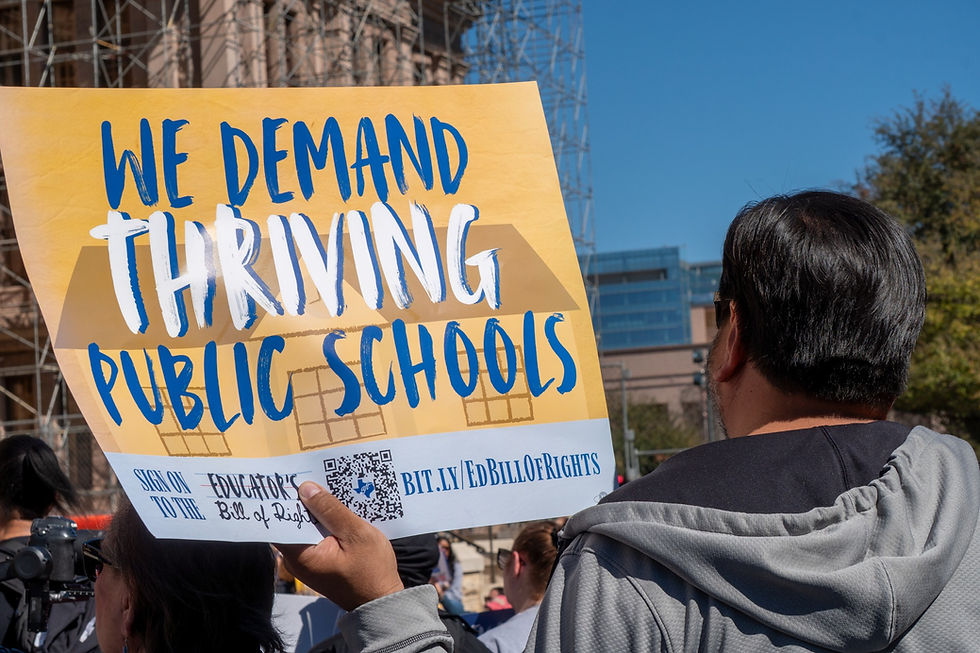
Texas schools are approaching a fiscal cliff, leaving many districts out of options
School districts across Texas are heading into one of the most difficult budget cycles in years, with administrators warning that many districts are nearing a fiscal cliff driven by declining enrollment, inflation, expiring federal funds, rising insurance and healthcare costs, and holes in a school funding system that still haven’t fully caught up with the realities districts are dealing with.
Some public finance analysts estimate that at minimum, 40% of Texas districts could face serious financial stress this budget cycle, particularly districts already dealing with enrollment losses or limited reserve funds. And while House Bill (HB) 2 provided some belated state funding and adjustments to the school's finance system, many district leaders say the legislation provided a little breathing room without wholly solving the underlying problem.
Enrollment trends are shifting in ways that directly impact district budgets. In urban and suburban districts, charter expansion, inflated housing costs, and population movement are shrinking student counts, which means less funding under the state’s attendance-based finance system. At the same time, district expenses have continued rising much faster than state funding formulas, putting many districts in deep financial trouble. Insurance costs, utilities, transportation, employee healthcare, and other basic operational expenses have all increased rapidly over the last several years, while districts are also trying to retain teachers and staff in an increasingly competitive labor market.
The result is a growing number of districts now discussing school closures, consolidations, staffing cuts, and tax ratification elections just to remain financially stable.
In Pasadena ISD, district leaders recently began discussions around campus consolidations and possible school closures tied to declining enrollment and budget pressures, part of a broader trend happening across the state as districts try to reduce operational costs while maintaining services for students.
Additionally, El Paso ISD may be facing one of the starkest examples of the crisis. In recent weeks, district officials revealed a projected budget shortfall that local reports have placed as high as $52 million, triggering discussions about layoffs, emergency financial measures, and possible long-term restructuring. Trustees said they were shocked by the scale of the deficit, particularly after learning that more than $21 million in spending had allegedly occurred without board approval. Community discussions have already turned toward the possibility of school closures and major staffing reductions if the district cannot stabilize its finances.
Even districts that appear more financially stable on paper are warning that reserves are shrinking quickly. Cy-Fair ISD, the third largest Texas district recently projected at least a $67 million budget deficit for the upcoming school year, with district officials warning they are approaching a “financial crisis” if additional revenue or state relief does not materialize. District leaders have openly discussed possible personnel cuts, tax increases, and the continued elimination of positions like librarians and counselors if conditions worsen.
That broader pressure is part of why HB 2 became such a major focus during the legislative session. The bill includes adjustments to school funding formulas, compensation requirements, and hold harmless provisions tied to tax compression. Some school finance groups have noted that some districts will see some meaningful short-term increases in state aid under the new structure, particularly through changed maintenance and operations funding formulas and tax protections.
But even districts receiving additional funding under HB 2 are warning that the increases may not fully offset the financial pressures they are facing. In presentations reviewing the legislation’s impact, districts including Fort Worth ISD acknowledged that enrollment declines and broader economic pressures continue to threaten long-term stability despite new state funding streams.
This is the larger issue now confronting public education in Texas. Many districts are no longer dealing with temporary budget challenges tied solely to the pandemic or inflation growth. Instead, they are entering a period of structural financial instability where rising costs and declining enrollment are colliding at the same time.
For educators and families, that reality increasingly shows up in tangible ways: larger class sizes, fewer librarians and counselors, delayed campus maintenance, reduced programming, hiring freezes, and discussions about school consolidation that would have seemed politically impossible just a few years ago.
The political rhetoric around public education often focuses on test scores, accountability ratings, or culture war debates, but district budget meetings across Texas are increasingly centered on something much simpler, how to keep schools operating without cutting deeper into staffing and student services.
As more districts begin warning about deficits, closures, and shrinking reserves, it’s becoming harder to ignore that Texas public schools are entering an era where financial instability itself may become one of the biggest threats facing both students and educators.